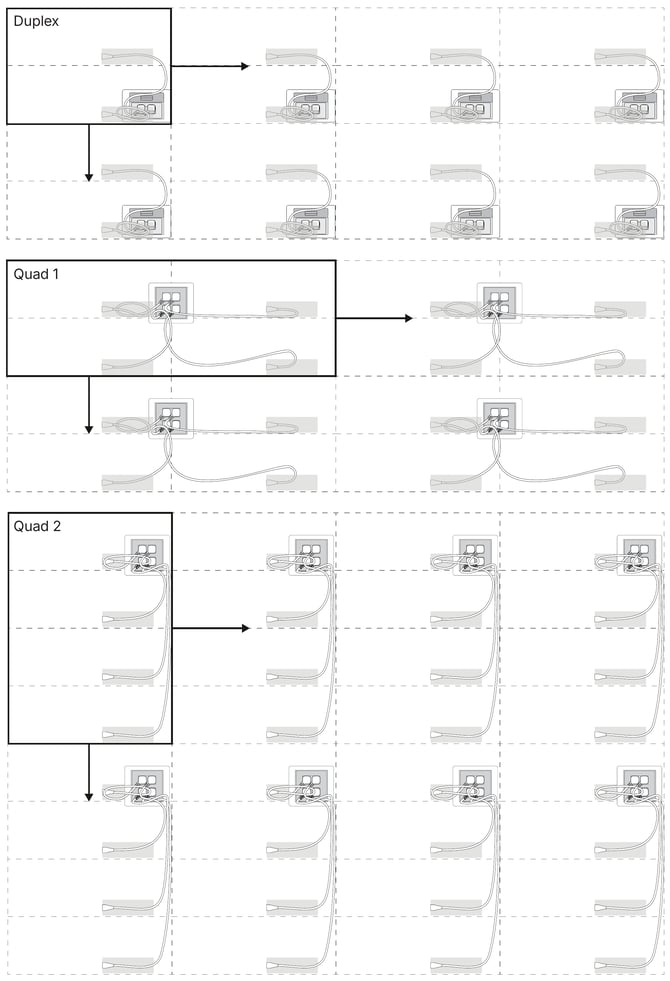
Every Note needs a place to plug in. For most walls, we recommend a standard outlet behind each Note or a recessed duplex box shared by two stacked Notes.
Before you begin
- Mark outlets with the wall templates. Each template shows where its Note's outlet can go. See How do I lay out a Note Array with the wall templates?
- Install outlets before the wall plates. Your electrician will need open wall to work.
- Check your circuit. See How many Notes can share a circuit?
- No outlet possible behind the array? See What if I can't put an outlet behind every Note?
Quick reference
|
Outlet |
Powers |
Where it goes |
Cord |
|---|---|---|---|
|
Standard |
1 Note |
Behind each Note |
Right-angle cord, included |
|
Recessed duplex |
2 Notes, stacked |
Behind the lower Note |
Straight C5 cord, sold separately |
|
Recessed quad |
4 Notes |
Where two stacked Notes meet |
Straight C5 cord, sold separately |
Option 1: A standard outlet behind each Note
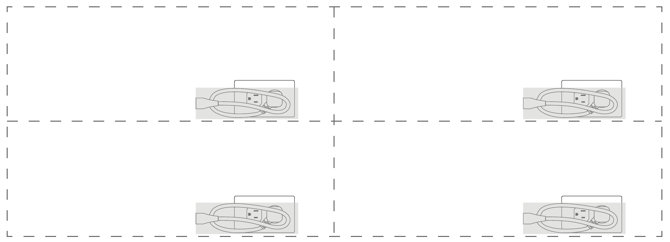
- Install a standard outlet horizontally inside the marked area, right behind the Note's connectors.
- The right-angle cord in the box is made for this spot. No extra cables needed.
- The cutout on the back of the Note hides the plug and cord.
Option 2: A recessed duplex outlet for two Notes
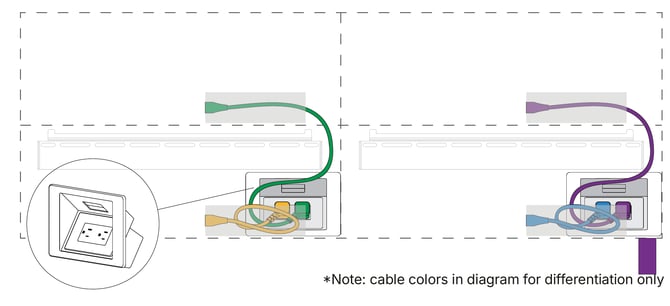
- Install a recessed duplex box behind the lower of two stacked Notes.
- Both Notes plug in there. The upper Note's cord runs down to it.
- The box sits flush with the wall, so the Notes hang flat.
Option 3: A recessed quad outlet for four Notes (only with room to spare)
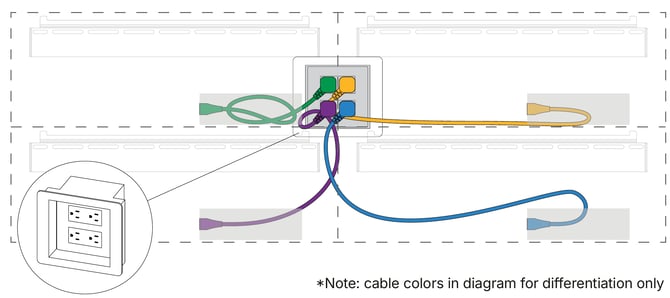
- Install a recessed quad box at the edge where two stacked Notes meet.
- It can serve a 2 × 2 block of Notes, or a single column four Notes tall.
- A quad box sits close to the wall plates, which leaves little room for cords and hands. Choose it only when your layout has space to spare, and check the fit on the templates first.
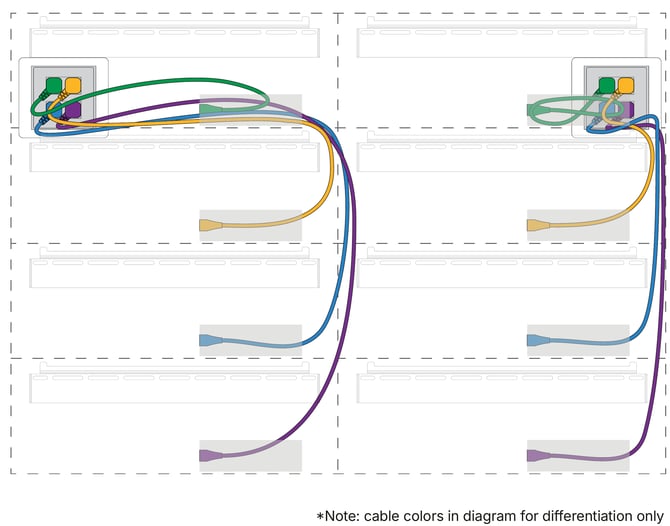
Whichever you choose, a recessed box is the better fit when Notes mount flat against a finished wall.
Scaling up
Pick one pattern and repeat it across the wall. On most arrays that's a duplex box for each stacked pair.